Main Menu
- Home
- Product Finder
- Calibration Systems
- Calibration Services
- Digital Sensing
- Industrial Vibration Calibration
- Modal and Vibration Testing
- Sound & Vibration Rental Program
- Non-Destructive Testing
- Learn
- About Us
- Contact Us

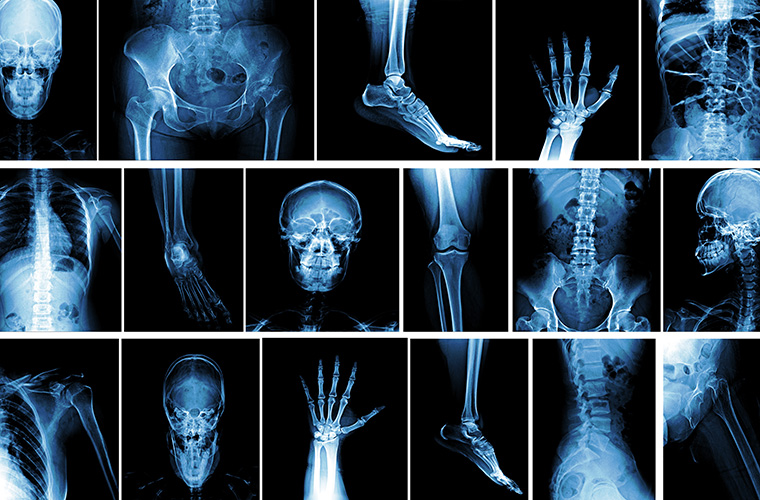 Researchers in a study coordinated by Ohio University through the Ohio Musculoskeletal and Neurological Institute (OMNI) are exploring ways to assess bone strength by measuring how bones respond to mechanical forces. A study protocol published in JBMR Plus describes research into Cortical Bone Mechanics Technology (CBMT), which uses vibration analysis to evaluate the bending stiffness of the ulna, a bone in the forearm.
The goal is to investigate whether these measurements can provide useful information about fracture risk beyond conventional bone mineral density measurements.
In the CBMT test being studied, the participant’s forearm is carefully positioned and supported in a fixture to minimize movement and provide consistent test conditions. A probe contacts the forearm, allowing The Modal Shop’s SmartShaker™ to apply controlled vibrations to the ulna, the bone being evaluated.
An impedance head measures both the applied force and the resulting acceleration, capturing how the forearm responds to the vibration. The DigiDAQ® signal conditioner acquires these signals and makes it easy to transfer them to custom software for vibration analysis to characterize the forearm’s mechanical response and estimate the ulna’s resistance to bending.
Together, the SmartShaker, impedance head, and DigiDAQ provide the controlled excitation and measurement capabilities needed for this vibration-based approach to studying bone strength.
Measuring the mechanical response of a bone requires controlled excitation and accurate data acquisition. The Modal Shop’s SmartShaker and DigiDAQ offer complementary capabilities for laboratory vibration experiments.
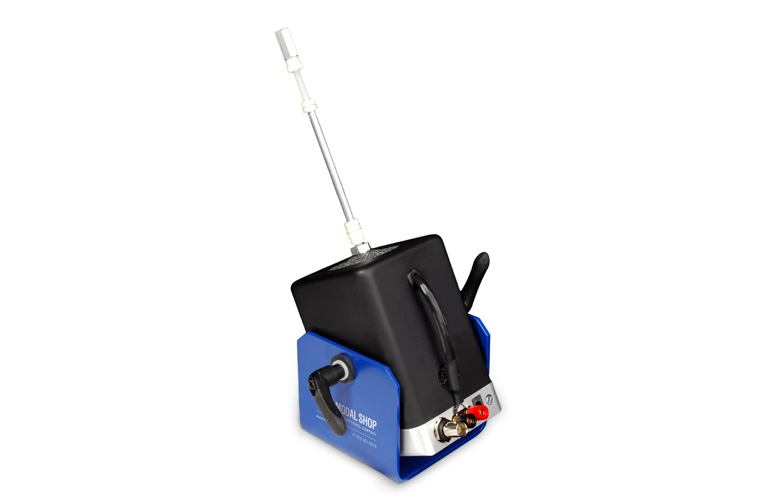
The SmartShaker is a compact electrodynamic shaker with an integrated power amplifier. It provides controlled mechanical excitation for testing structures and materials. In research applications, this type of shaker can help investigators study how a specimen responds to forces at different frequencies.
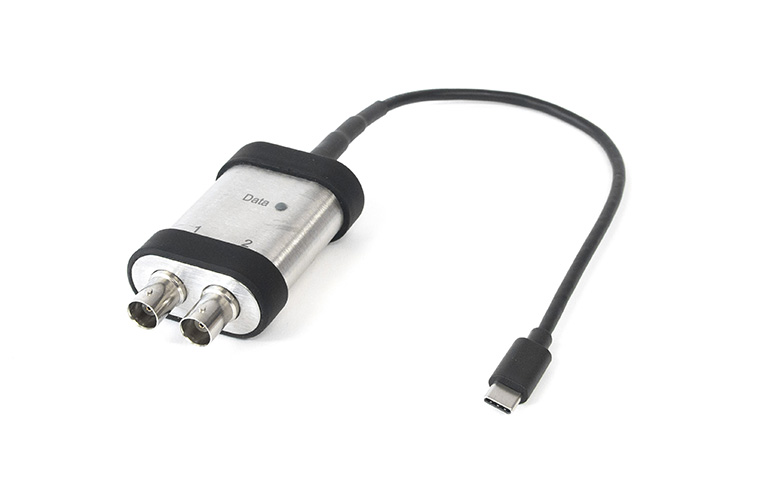
The DigiDAQ Digital ICP® USB Signal Conditioner connects compatible sensors to a computer or mobile device for data acquisition. Its two input channels allow researchers to capture two signals simultaneously, supporting analysis of a specimen’s response to mechanical excitation.
Small and portable, DigiDAQ makes it easy to stream acquired signals directly to a connected device without installing additional drivers. Researchers can access the data through the device’s standard audio driver, simplifying integration with custom software for signal processing and analysis.
This straightforward connection helps researchers focus on their experiments rather than complex data acquisition setup. Using compatible software (whether off-the-shelf or user developed), they can examine time waveforms, frequency spectra, and frequency response measurements to better understand mechanical behavior.
Contact The Modal Shop to discuss your research requirements and find the right instrumentation for your application.
Warden, S. J., Dick, A., Simon, J. E., Manini, T. M., Russ, D. W., Lyssikatos, C., Clark, L. A., & Clark, B. C. (2024). discrimination capability of ulnar flexural rigidity measured via Cortical Bone Mechanics Technology: study protocol for The STRONGER Study. JBMR Plus, 8(1).